
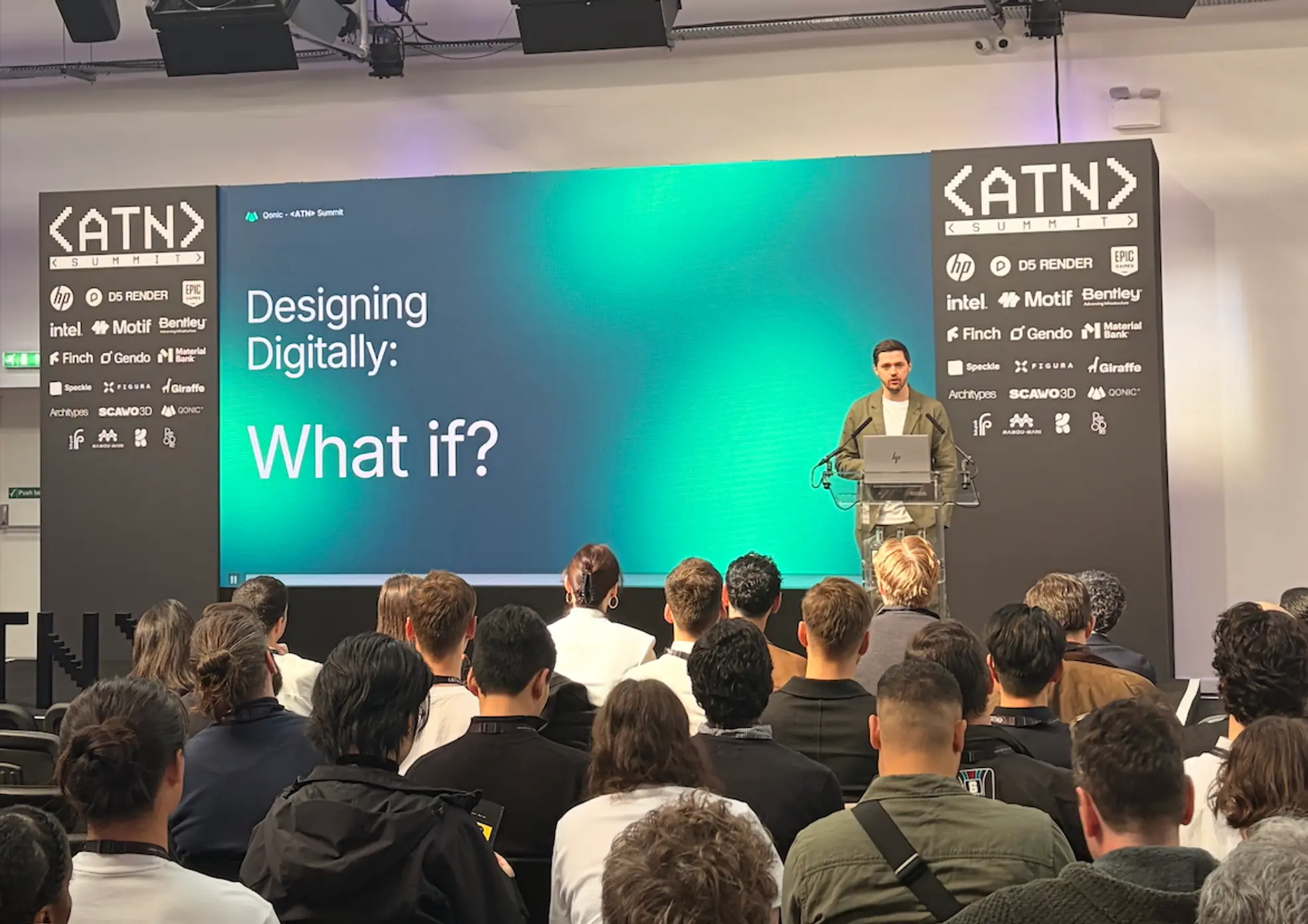
By Aaron Perry — Head of Industry at Qonic. This post is based on his presentation at the ATN Summit in London.
There is a question most people in architecture have felt at some point, but rarely want to acknowledge.
What if the barriers we work around every day simply weren't there? What if design tools didn't slow us down, fragment our work, or force us into compromises we've learned to accept?
That was the question I brought to the ATN Summit in London. Not as a thought experiment. As something practical.
A complicated relationship
I spent ten years as Head of Digital Design at AHMM Architects, contributing to the delivery of some of the UK's most significant projects. Projects people pass on their way to work. Work I'm proud of. Over time, though, something shifted.
The promises software marketing was making were not coming to fruition. The tools being pushed to help improve efficiency were helping in ways, but between constraining most designers’ creativity and requiring a momentous amount of pre-configuration, training, maintenance and support, my enthusiasm was declining and the frustrations increasing. I wasn't alone.
Together with other architects and design leaders, we authored an open letter, signed by hundreds across the industry. With dismissal and little change, we changed our approach and put pen to paper on the Future of AEC Software Specification: a clear articulation of what modern design software should be. With the future requirements clearly set and with my energy now focused on obtaining it, I was introduced to Qonic.
The Instagram vs. Reality problem
There is a lot of optimism about AI in architecture and a lot of scepticism too. What you see online rarely reflects what happens on a real project. As an industry, architects optimistically envision how space could be used and maintained through beautiful renders and sketches. AI is making it easier than ever to create beautiful images and videos to express concepts and design ideas.
Open LinkedIn on any given day and you'll find headlines about AI fully automating design. I certainly can see an opportunity for rule-driven design, in engineering, for instance. But for typical architectural work? As Roderick Bates of Chaos put it: "architects remain responsible for shaping, refining, and realising concepts in the real world."
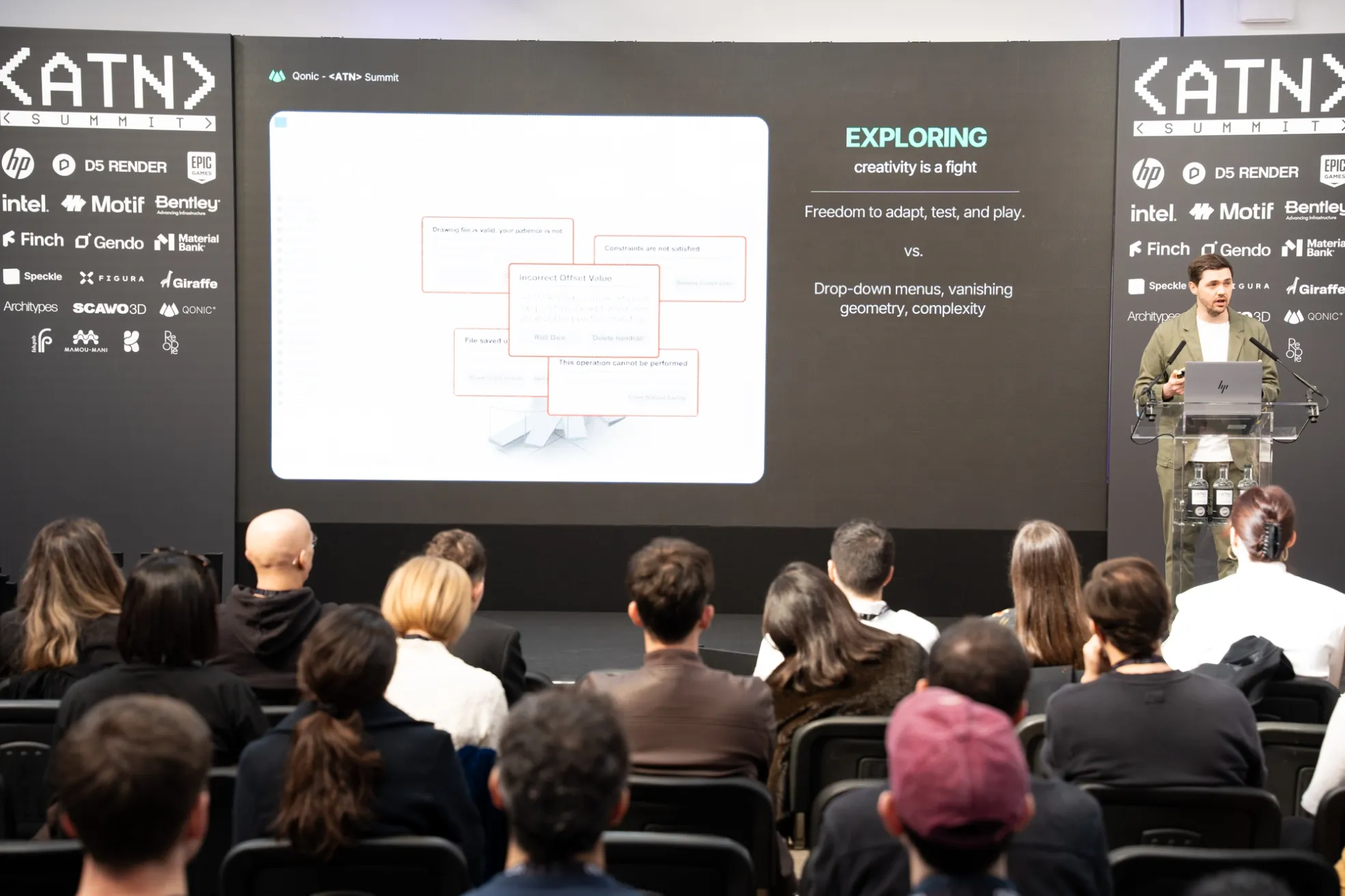
That part is easy to overlook. Design still needs to evolve, be adjusted, tested, built. At that level, a prompt doesn't help you. You fall back on the tools you already have. And those tools were already struggling. The industry didn't adopt complexity because it works. It adopted it because there was no alternative.
The high cost of normal
Each week, we deliver projects without wanting to acknowledge a problem. Capturing an idea is harder than it should be when the interface itself takes months to master. Accessing a model still means waiting or not being able to open it at all, because a licence hasn't been assigned yet. Collaboration depends on everyone being in the right tool, the right version, the right setup. Validation comes too late, because analysis requires rebuilding the model somewhere else first. And deliverables still consume the majority of time: built manually, checked manually, and often misunderstood by the person receiving them.
None of this is unique. That's the problem. We’ve learned to tolerate broken tools. More plugins, more translations, more time, more money. Not as solutions, but as workarounds for a problem no one wanted to deal with.
We don't have to accept this.
What do we actually want?
Not more translations. Not more workarounds.
A modelling environment that adapts to design, not the other way around. Access for anyone involved in the project, without friction or licence overhead. Collaboration that happens where the work actually is. Analysis and validation that happen in time, not after the fact. And deliverables that come from the model, not from rebuilding it.
This is not an unrealistic list. It's a practical one. And it is the specification Qonic was built to meet.
What that looks like in practice
Two outcomes when the friction is gone.
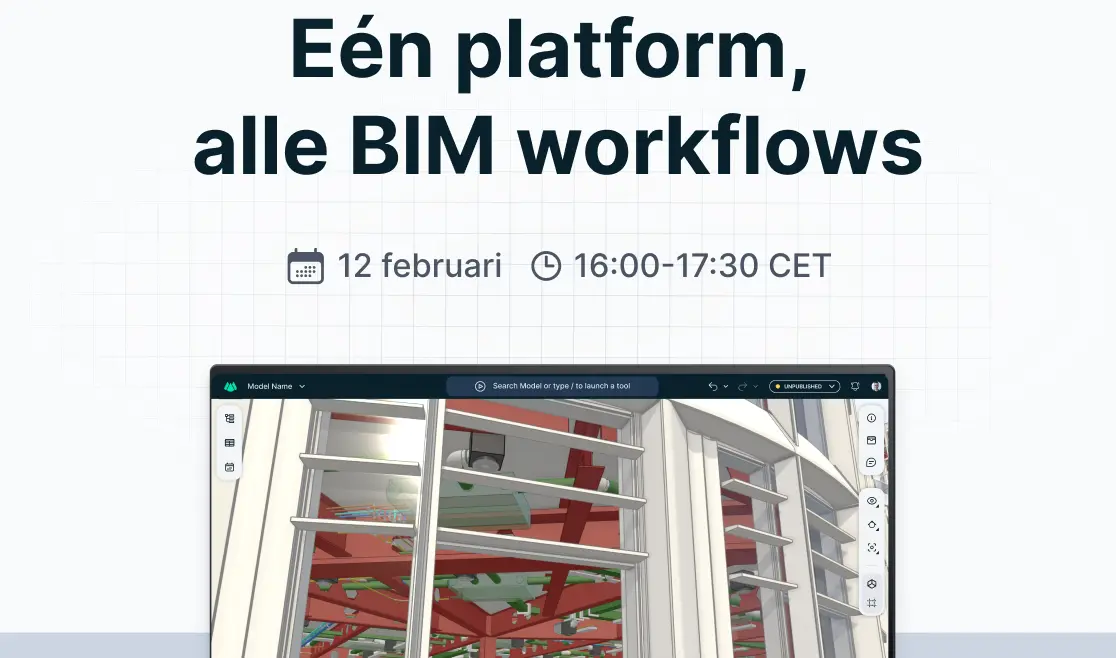
The first is access. Open every model simultaneously - architecture, structure, HVAC - together with full city context, in seconds, in a browser. Have the same experience whether on a construction site, in a meeting room, or working from home. No simplified or detached versions, no waiting, no dedicated hardware. Share a link with anyone, open the model without a licence or installation, review it, and move a decision forward. A centralised conversation, happening inside the model itself, with everyone.
The second is a better way to create traditional deliverables and to generate more trust in the model being a deliverable itself. Easily set up a plan or section view, choose a drawing style, and automatically generate annotated drawings with dimensions and tags. Adapt the automations, add additional ones, or export as PDF or DWG. A clean, structured base drawing. Final review still happens, as it should. But the hours spent building the drawing from scratch are gone.
With the traditional modelling restrictions (performance, difficulty to develop, etc.), models can become more detailed, where they can be better utilised and trusted by others. The model itself becomes a better deliverable.
These are not features. They are the difference between work that flows and work that accumulates friction until something breaks.
A word on existing workflows
No practice is going to replace its entire workflow overnight. Nor should it.
The friction points are well known: access, coordination, communication, deliverables. That's where change matters most. Qonic works alongside existing models: import from Revit, SketchUp, Rhino, and keep the data intact. The entry point is low. The full design team gets access from day one.
Freedom is one part of the story. The other is structure. The IFC hierarchy, object classification, and data management are built into the modelling environment. Flexibility and rigour coexist. That is the point.
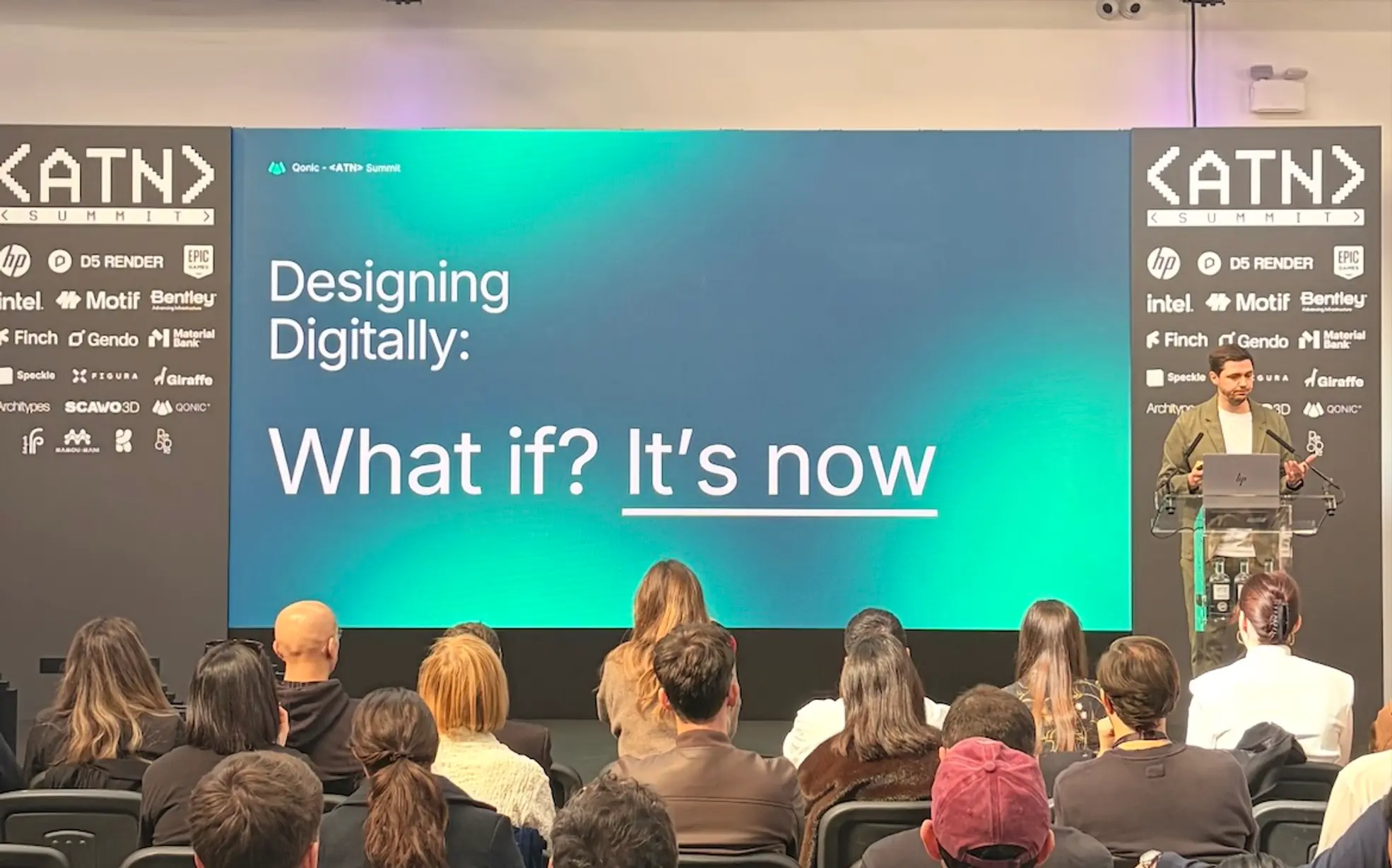
What if? It's now.
The question I opened with - what if the barriers we work around every day simply weren't there - is no longer hypothetical. I used to think the problem was finding the right tool. It wasn't. The real problem was accepting that the tools we had were "good enough." They weren’t.
The question has shifted. It’s no longer about what if. It’s about why we waited so long to demand better.
Qonic is the answer to that shift. A modelling engine built for speed, cloud-native, and ready for your most complex models. If you want to see what it looks like with your own model, you can try it today for free, no commitment.
You can start in Qonic today, with your own model. app.qonic.com
About
Aaron Perry Head of Industry, Qonic. Aaron spent a decade as Head of Digital Design at AHMM Architects, contributing to the delivery of some of the UK's most significant projects. Over that time, he co-authored the Future AEC Spec - an open-source document setting out what modern design software should be - and eventually joined Qonic to help make it a reality.
He works directly with architecture and design firms navigating BIM adoption, workflow transformation, and the gap between design intent and technical execution.
FAQ - Questions this article raises
Why do architecture practices still rely on so many different software tools? Most practices didn't choose complexity; they accumulated it. Each tool was added to solve a specific problem that the previous one couldn't handle. Over time, the stack grew: one tool for modelling, another for coordination, another for clash detection, another for drawings. The result is a workflow held together by exports, manual transfers, and workarounds rather than a connected system.
Is the problem with BIM tools really that bad or is this overstated? In 2022, AHMM Architects, one of the UK's most digitally advanced practices, published an internal review of their own software portfolio. Their own conclusion was that a lack of seamless integration between tools was one of their leading sources of wasted time. If that is the situation at a practice with a dedicated Digital Design Group, it is almost certainly worse at practices without one.
What is the Future AEC Spec, and why does it matter? The Future AEC Spec is an open-source document co-authored by Aaron Perry and other architects and design leaders, setting out what modern design software should actually be capable of. It was written after an open letter to software developers - signed by hundreds across the industry - failed to produce meaningful change. The spec exists because the people who use these tools every day had stopped waiting for vendors to improve them and decided to define the standard themselves.
Why does it matter that BIM models are slow to open? Loading time is rarely discussed as a serious issue, but it compounds significantly across a team. If ten people on a project each wait five minutes a day for models to load, that is nearly an hour of lost time per day across the team or roughly twenty working days per year. Beyond the time cost, slow access changes behaviour: people defer decisions, work from older versions, or skip opening the model altogether. That has a direct impact on design quality and coordination.
What does it mean for a BIM platform to be cloud-based? A cloud-based or browser-based BIM platform runs entirely in a web browser, with no software installation, no dedicated hardware, and no licence assigned to a specific machine. Anyone with a link can open the model, on site, in a client meeting, or working remotely, without IT involvement or access management. This is the same shift that happened with documents and spreadsheets when they moved to the cloud, applied to building models.
What is the difference between IFC as a native format and IFC as an export? Most BIM tools store data in a proprietary format and convert to IFC when exporting. This conversion is imperfect because properties get lost, classifications shift, and geometry degrades. Qonic is different: its internal data model is built around IFC from the ground up, so the structure is correct from the moment you start working. There is no proprietary Qonic format: when you export, you export to IFC or back to a tool like Revit, without the usual data loss or cleanup that comes from converting between incompatible formats.