Everyone in the openBIM conversation is talking about standards. Which version of IFC. Which level of detail. Which buildingSMART certification. All of it matters. All of it lays the foundation.
But the foundation isn't the finish line.
The hard part is getting those standards to work in the hands of people who are not standards experts. That's the gap where most openBIM efforts stall and it was the central argument Mark Van Den Bergh brought to the Porto Summit 2026, as part of the Voices of openBIM series.
As CEO and Co-Founder of Qonic, with more than 25 years in the AEC software industry, Mark brought a perspective the series needed: the software industry's role in making openBIM actually land in daily practice.
"I think there is a trend that people understand to have more freedom and where they don't want to be locked in by software vendors. So in that sense, I see a very nice evolution into more open standards."
Watch the full interview with Mark Van Den Bergh here:
Where standards meet practice
Open standards are a specification. They define what data should look like, how it should be structured, what an IFC file should carry. That work — done by buildingSMART and the broader openBIM community — is essential.
But a specification is not an experience.
Most people working in AEC are not IFC experts. They're architects completing a design, contractors managing a programme, information managers trying to make sure data arrives clean. For these people, a standard is only as useful as the software that implements it. When BIM tools require specialist knowledge to operate, they create a dependency. The standard becomes inaccessible by default.
After more than 25 years in the industry, this is Mark's core belief: the ability to structure, visualise, and make information something a whole team can actually work with. The real value of an IFC file comes when every member of the project team can use it.
Where openBIM comes to life
IFC, open data structures, and semantically understandable models provide the foundation. What decides whether that foundation is actually useful is how it's implemented in software, whether the tools that sit on top make the data manageable for a broad range of users, not just the technically fluent.
Mark's framing is direct: software is the intermediary between a well-written specification and something a project team actually uses. The standard logic goes like this: standards bodies write the spec, vendors implement it, users adopt it. But that middle step, implementation, is where adoption is actually decided. The software industry needs to own that.
The numbers reflect where the momentum is. The buildingSMART Validation Service checked approximately 56,000 IFC models in just 18 months, a figure that speaks to how far real-world adoption has already come.
Across Europe, IFC is gaining significant traction as the shared language for construction companies, design firms, and owner-operators. In the Middle East and Asia, adoption is picking up too.
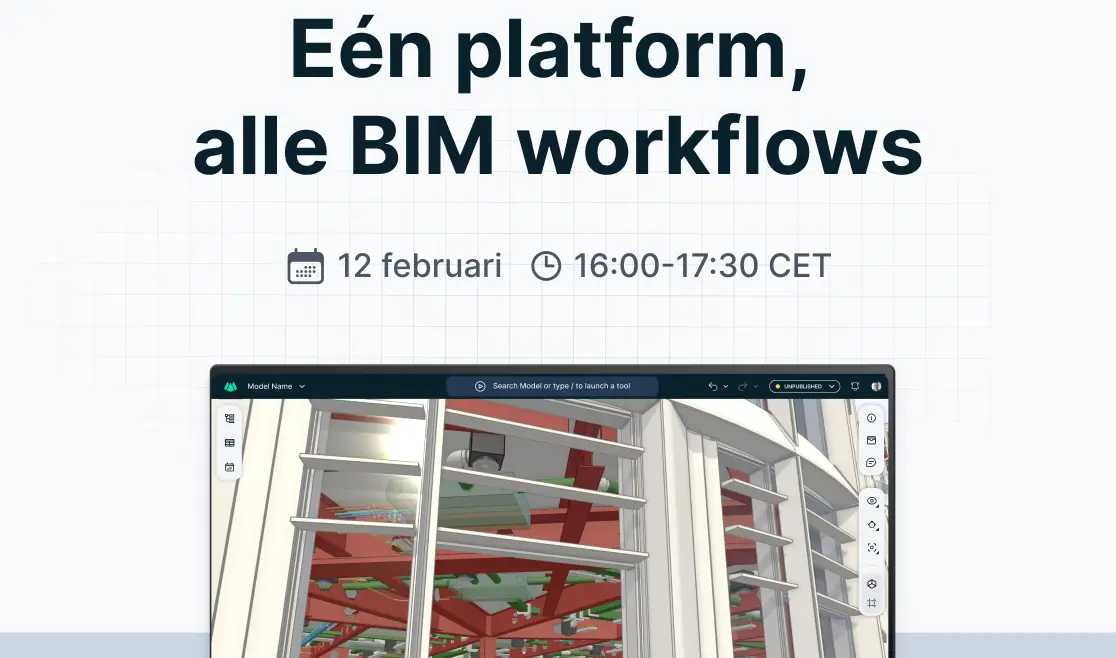
Qonic is built on exactly this principle. As a browser-based BIM platform built around open IFC, it's designed to reduce the distance between the standard and the person who needs to use it. It runs in a browser, on any hardware, without conversion steps between tools. IFC models that take 50 seconds to open in traditional desktop software open in under 3 seconds. The openBIM infrastructure, made operational.
To understand why openness is a design principle at Qonic rather than a feature, 'Built for connection, not isolation: Why openness drives the Qonic mission' is worth reading.
What AI changes and what it doesn't
Looking ahead, Mark connects openBIM directly with AI and the way he frames it is specific.
BIM means working with both data and geometry from all kinds of sources. That combination needs a common language. "You have to have a common denominator, you have to have a common language," Mark says. "And then you can start in a smart way applying AI and all the new techniques to enhance and automate even a lot of things."
The prerequisite is clear: "If you have the foundations right, and open standards help with that, then of course you can start to do smart things using AI machine learning."
But it's not about handing your data to a generic tool. "People want to make sure they can use their own models, their own knowledge, and then apply AI machine learning on those." That distinction matters. AI built on your own IFC-native data compounds. AI built on fragmented, proprietary data amplifies the problem.
For a closer look at how Qonic Intelligence builds on open IFC as its foundation, 'Clean IFC by default: Qonic Intelligence (QI)' goes deeper.
"We want to democratize the whole BIM process," Mark says, "not only for the BIM specialists, but really to open it up. And AI can help there as well. Tremendously."
It's an exciting time.
Where IFC goes next
One area Mark is watching closely is the evolution of IFC itself. His view: the standard needs to move toward the granular object level. "I think it's too much of a monolithic thing today," he says. The goal is version management, history tracking, and full visibility of what changed across the life cycle of a built asset from design through construction to operation.
Qonic already works this way internally: geometry separated from data, data structured at the object level, changes tracked. It's the direction the broader standard needs to follow. "Any initiatives that help in that sense, we would love to embrace," Mark says.
The message to the openBIM community: the standard is strong. The next step is making it granular enough to carry the full weight of a project from start to finish.
This interview was recorded at the buildingSMART Porto Summit 2026, as part of the Voices of openBIM series.