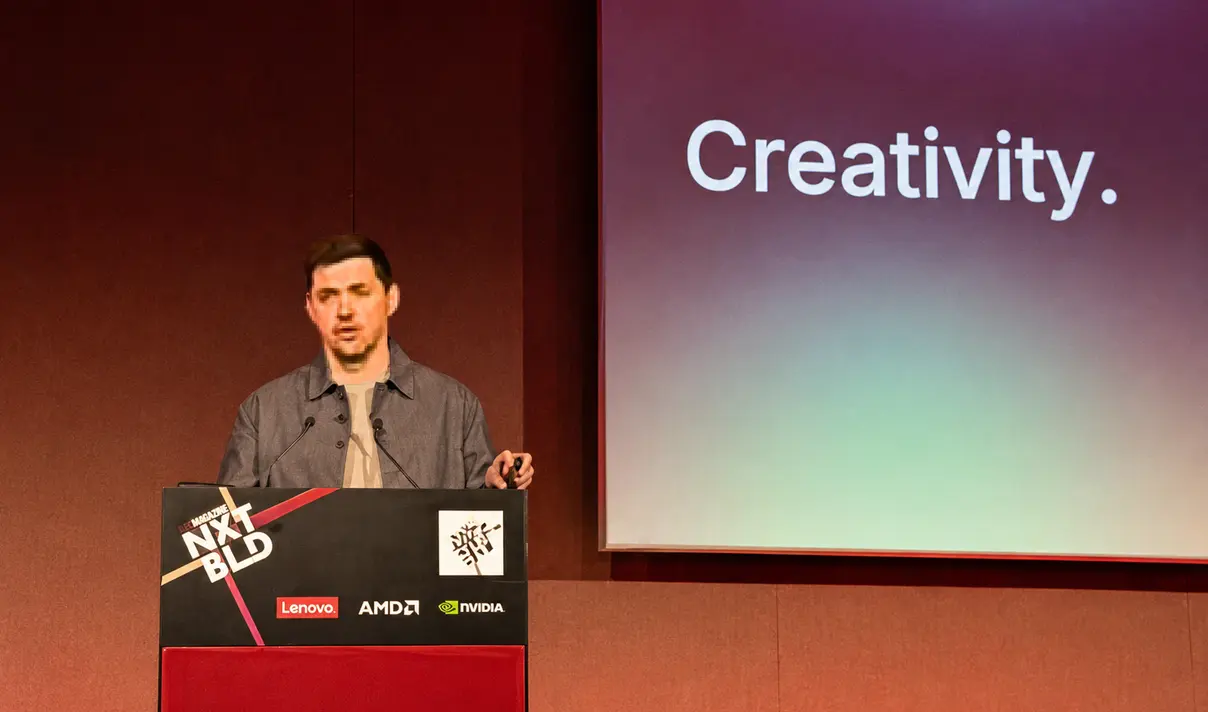
This is the last in a three-part series from Aaron Perry's NXT BLD 2026 presentation. Read part one.
Why would you not build your technology and software stack using open industry standards? Why would you not ensure flexibility to use the tools you want to use?
Think of all the tools, plugins, and emerging technology that you wish you could be using, but the problem is getting design work between them without losing geometry or data.
Qonic is IFC in and IFC out. Based on open industry standards. Use the tools you want to. Inherit models, connect with open standards like the BSDD, BCF and IDS, connect with specialist tools through our open APIs, connect with the specialist tools that you need. Extract all information to industry standards so you can deliver openBIM, avoid any commercial locks-in.
This approach and your engagement with partners can enable you to:
- Retain muscle memory and extend your creativity
Extend the value of the tools you already love to use, such as Rhino, by importing models into Qonic. The geometry remains editable, our ML automatically classifies as a structure IFC hierarchy, and any updates to the models are handled as only ‘diffs’, meaning we don’t lose any updates you’re making in Qonic. If you’re using Grasshopper, we also support the ability to ‘bake’ the outcomes directly in Qonic.
- Whilst designing, have contextualised design development.
Understanding how your design works in context is critical. Finding quality data is expensive and cumbersome. In traditional software, when you create a new model, it’s floating in blank white space. How does the building sit in context, height, volume? How does the building meet the ground? Landscape? Street/Pavement? What about Orientation? Ideal views? Etc. With Qonic being so open, we can connect with 3D tiles, for example, Cesium by Bentley, to get the contextual point cloud, Gaussian Splat, and 3D photo tiles. We can understand the impact of our design, whilst designing. All without impacting performance.
- Implement specialised Agents from tools you might need
As an industry, we’ve never been able to understand how the design can/cannot be delivered by construction systems/products. With Qonic’s approach to openness, we can easily connect to 3rd party specialised agents, like KOPE. KOPE converts design intent into high-fidelity construction products in seconds. It enables configuring and optimising building systems. It makes constructability computable. Whilst designing, I can know the limitations and the impact on supply chain options: wastage percentage, Embodied Carbon values. KOPE’s agent is updating the panelisation, as I design. Interact with Manufacturer levels of detail. Threads on screws. You may be very uncomfortable with this idea, having spend the last decade reducing detail for performance, making BIM less useful for others. Making fewer people be able to use models. Today we announce the industry’s first ‘Agentic Integration’, between Qonic and KOPE.
The industry has made BIM less useful: stripping out detail, dumbing down models, all in the name of performance and control. We think that trade-off wasn't necessary. With open standards and Agentic Integration, you don't have to choose between usable models and rich ones, between your favorite tools and a connected ecosystem. Qonic and KOPE are proof that openness scales all the way to manufacturer-level detail without slowing anyone down.
Want to see what building on open standards and connecting agents looks like for your own projects? Talk to our team, or try Qonic for free and find out yourself.