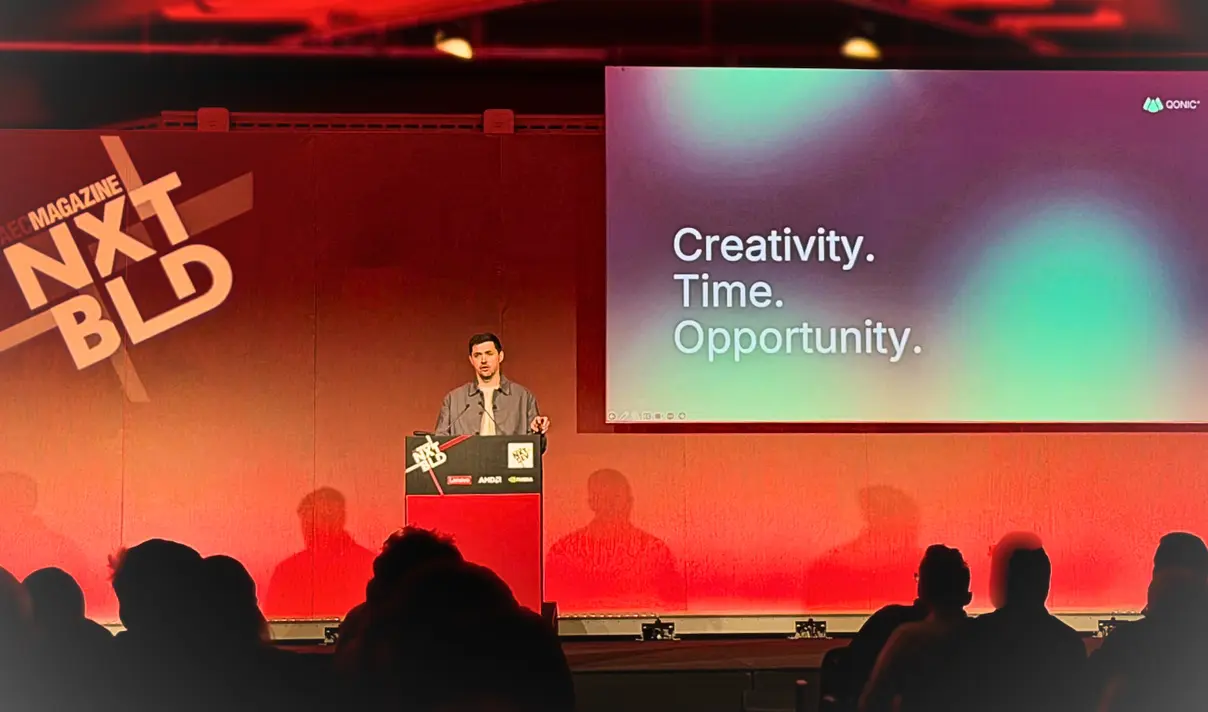

At NXT BLD, I explored three themes that I think matter more than ever for our industry: Creativity, Time, and Opportunity. This first piece is about Creativity and why it matters more than ever.
Your creativity is directly linked to how easy it is to capture an idea and communicate it with others. That is what we built Qonic around.
Most modelling tools make you choose
Direct modelling for early-stage freedom, object modelling for production. You switch tools, you lose continuity, you lose time.
In Qonic, you do not have to choose. Direct and object modelling work together, throughout the life of the project. Start with a form, mature it into a fully specified building element, inherit your organisation's content library, place components across the model.
Not one or the other, but both direct and object modelling at the same time throughout the life of the project. No pop-ups… Constraints… No locking of floor-to-floor heights or pre-specification of wall buildups before you’ve even started. Just freedom, flexibility, and speed.
The geometry problem nobody talks about
Here is something I see constantly. A team tries to bring geometry from Rhino or anywhere outside their BIM stack into their modelling tool. The problem is unclassified forms, with no structure, despite your efforts with plugins. Traditional tools still panic and can’t recognise the geometry forms and crash.
Qonic can easily classify that geometry using machine learning to automatically allocate the appropriate IFC Class and the geometry remains editable in Qonic! All with detailed BIM data, classifications, specifications, connections with bSDD, or a custom client data library.
No limits on scale or complexity
Qonic does not care if this is a five-storey residential block or a fifty-storey mixed-use tower. A historic building or a dense data centre. A distribution warehouse or a major sports venue. It makes no difference in Qonic. Just unlimited and amazing performance. Every single edge, surface, and object is there ready to be adapted and adjusted.
Why this matters technically
I will be direct about what makes this possible, because I think it matters.
This is NOT approximated mesh geometry that you see in some other tools. Qonic is built on our own modelling kernel, our own code. It’s not a licensed kernel where they’d only be able to build tools if the relevant code in the kernel is available and has been exposed for them.
That means full recognition of BREP and NURBS, an understanding of subD, and the ability to handle complexity that other browser-based tools simply cannot. Qonic is being used right now to design and deliver really complex projects, from Concept modelling through to As-Built levels of detail.
The result: you do not need to slow down, simplify, or spend ages opening models. Instantaneous performance, unrestricted flexibility and significantly reducing the time you spend waiting and fighting your tools.
What creativity actually needs
The existing tools were built in a different era and designed around constraints, hardware limits, file size limits, and collaboration limits that no longer need to exist.
Qonic was built without those constraints. And what I have seen, again and again, is that when the software stops getting in the way, people start doing things they did not think were possible.
That is what creativity needs. Not more features. Just fewer obstacles.
Curious how direct and object modelling work together in practice? Let's talk or try it yourself now for free: app.qonic.com.
Next: Time, how Qonic changes the pace of design development and coordination.
About
Aaron Perry Head of Industry, Qonic. Aaron spent a decade as Head of Digital Design at AHMM Architects, contributing to the delivery of some of the UK's most significant projects. Over that time, he co-authored the Future AEC Spec - an open-source document setting out what modern design software should be - and eventually joined Qonic to help make it a reality.
He works directly with architecture and design firms navigating BIM adoption, workflow transformation, and the gap between design intent and technical execution.