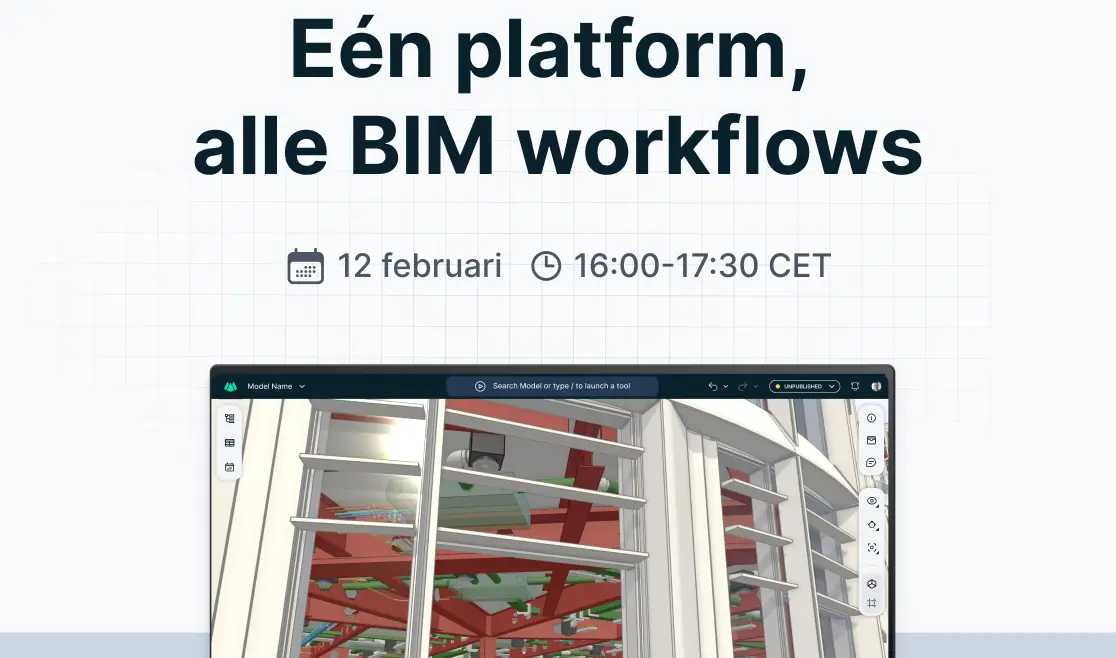
At the buildingSMART International Summit in Berlin, Louis Casteleyn, BIM Lead at Brussels Airport Company and active member of buildingSMART BeNeLux, presented a test case. He took Qonic, put it up against his real operational context, and asked a simple question: can this actually simplify the way we work?
Watch the interview with Louis Casteleyn:
The problem: the "fuzzy" link to operations
Brussels Airport manages a massive asset portfolio via IBM Maximo, backed by a solid BIM practice and a bSDD-aligned Object Type Library. However, the handover remains a bottleneck. As-Built models often get "stuck" in the BIM Office, losing their connection to Maximo. With multiple projects affecting the same assets simultaneously, maintenance teams end up without easy access to the information locked inside those models.
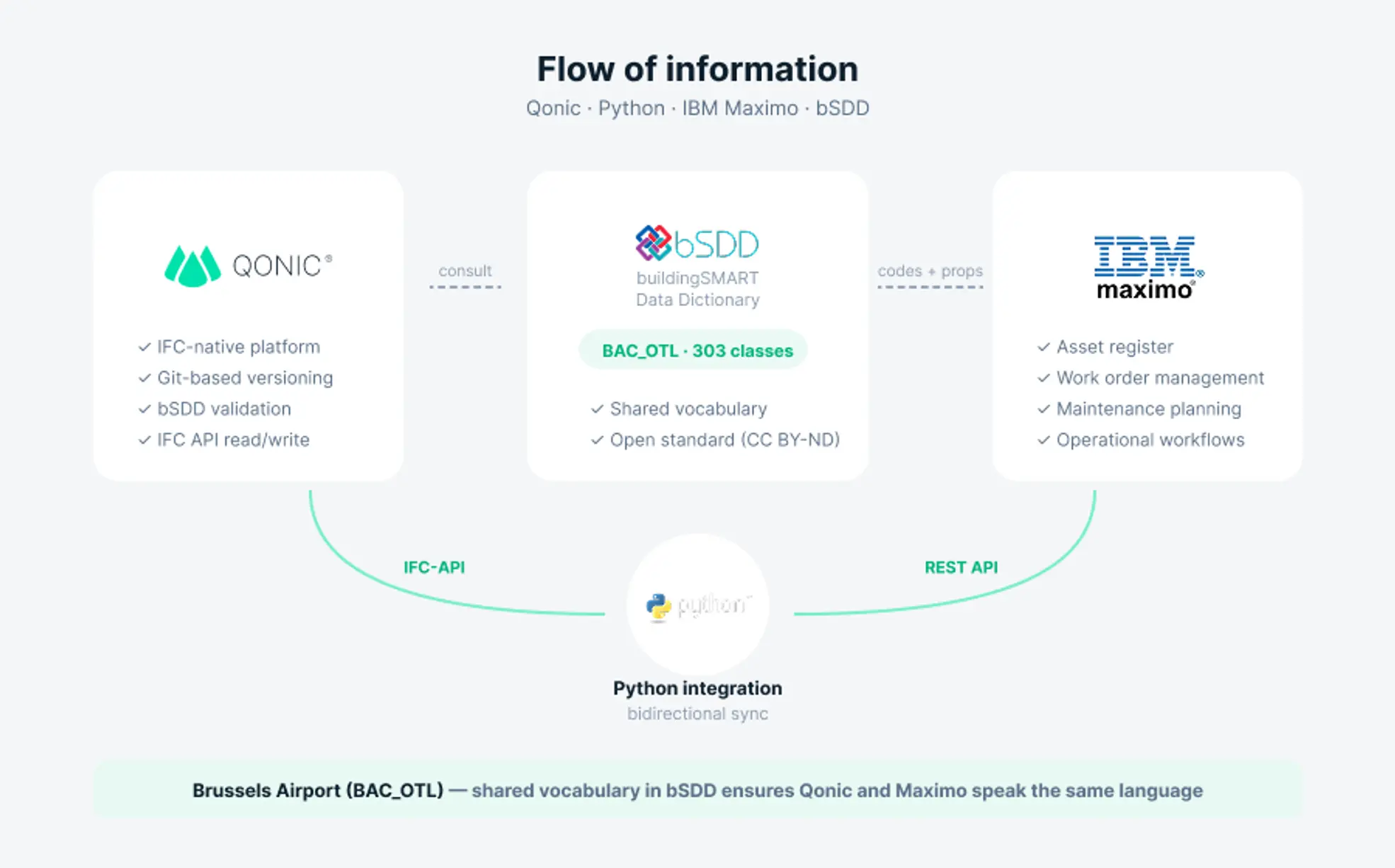
The test: direct, bi-directional data flow
Louis tested a lean integration: Qonic on the BIM side, IBM Maximo for operations, and a Python script to keep them in sync. This wasn't just a one-way handover, but a live connection. The key takeaways from the test:
- A Shared Language: By using bSDD, both systems speak the same "vocabulary". Qonic ensures the data is correctly structured before it ever reaches Maximo, acting as a bridge that validates logic in real-time.
- Low Barrier to Entry: Because Qonic is browser-based and IFC-native, you can read and update properties directly via API, no heavy authoring tools or seat licenses required.
- Structured Flexibility: Updates happen directly in the IFC data, making it easy to plug into larger data lakes or warehouse environments.
- Process vs. Implementation: Technically, almost everything is possible. However a rigid process needs to be in place on what data is hosted where, what is mirrored, where and who can modify it. There’s a need for a strategy on how Qonic is used within a broader IT landscape, that’s one of the findings of this test.
What's next: solving the parallel project paradox
One open question is how to handle change management when multiple projects hit the same asset at once. Louis showcased a versioning diagram: project branches and fast renovation branches that merge back into an AIM master.
This is where Qonic’s core architecture shines. Because Qonic uses Git-inspired branching, users can work on separate versions of the same model. You can "push" a renovation update when it’s ready, while a parallel maintenance project "merges" its own data into the master file. So you don’t have to guess anymore which version is the latest, or accidentally overwrite a colleague's work.
Where this lands: data is the foundation
The test showed that Qonic can meaningfully simplify the process: the IFC-native architecture, the bSDD connection, and the API access remove real friction. But the test also proved that a platform is only as good as the data it handles. The success of this workflow depends on the years of work Louis’s team put into their data foundation at Brussels Airport. Technology simplifies the process, but the data makes it work.
We're curious to see where it goes next.
Curious about how Qonic supports BIM-to-operations workflows? Start free at app.qonic.com, no installation, no seat limits. Or reach out directly. We'd love to show you what's possible on your own projects.
FAQ — Qonic at Brussels Airport
What problem did Brussels Airport face with their BIM data?
Brussels Airport manages a large asset portfolio through IBM Maximo, supported by a mature BIM practice. The bottleneck was handover: as-built models frequently got stuck in the BIM Office and lost their connection to Maximo. Maintenance teams had no easy access to the information locked inside those models, especially when multiple projects were affecting the same assets simultaneously.
How did Qonic connect BIM data to IBM Maximo?
The test used a lean integration: Qonic on the BIM side, IBM Maximo for operations, and a Python script to keep the two systems in sync. Rather than a one-way handover, this created a live, bi-directional connection between the BIM model and the operational system.
What role does bSDD play in this integration?
bSDD (buildingSMART Data Dictionary) gives both Qonic and Maximo a shared vocabulary. Qonic validates and structures the data before it reaches Maximo, acting as a bridge that ensures data is correctly classified and consistent across systems.
Why is Qonic well suited for BIM-to-operations workflows?
Qonic is browser-based and IFC-native, which means you can read and update properties directly via API without heavy authoring tools or additional seat licences. Updates happen directly in the IFC data, making it straightforward to connect to larger data lakes or warehouse environments.
How does Qonic handle multiple projects affecting the same asset?
Qonic uses Git-inspired branching, which means users can work on separate versions of the same model simultaneously. A renovation project can run on its own branch and be merged back into the master AIM when ready, while a parallel maintenance project does the same. This eliminates version confusion and prevents accidental overwrites.
What did the Brussels Airport test prove?
The test showed that Qonic can meaningfully reduce friction in BIM-to-operations workflows through its IFC-native architecture, bSDD connection, and API access. It also confirmed that a platform is only as good as the data it handles, the success of the workflow depends on the data foundation the team has built over years. Technology simplifies the process, but the data makes it work.
What is still an open question after this test?
Change management across parallel projects remains an area to develop further. How do you handle a situation where multiple teams are modifying the same asset at the same time? Qonic's branching model addresses part of this, but a clear organisational process — defining what data lives where, who can modify it, and how it syncs — is essential for any larger deployment.
Can Qonic integrate with asset management systems other than IBM Maximo?
Qonic's API-first, IFC-native architecture is designed to connect with broader data environments. The Brussels Airport case used IBM Maximo, but the same principles like structured IFC data, API access, bSDD alignment, apply to other asset management or CAFM systems.
Is this workflow available to other organisations?
Yes. Qonic is available immediately at app.qonic.com, with no installation and no seat limits required to get started. Organisations interested in BIM-to-operations integration can start with their own models and explore the API capabilities directly.