Open almost any BIM model and take a closer look at the mechanical systems inside it.
Elevators are usually represented as simple boxes with a few parameters attached.
HVAC equipment is often reduced to simplified geometry.
Complex assemblies such as conveyor systems, ventilators or access control installations are rarely modelled in any real detail.
In the earlier article on the technical foundations of BIM 2.0, Erik described BIM 2.0 as a technological reset. One that should support the entire building lifecycle, from early design to construction, operation, maintenance and eventual replacement.
Yet most BIM tools still treat mechanical systems as secondary objects. They are present for coordination, but not modelled with the precision required to support long-term use. As a result, facilities management teams inherit so-called digital twins that only loosely resemble the building they are meant to represent.
Why BIM 2.0 requires mechanical-grade precision
Modern buildings are no longer defined primarily by walls, slabs and columns. They are complex technical systems composed of interconnected assets, including:
- Mechanical assemblies such as elevators, HVAC systems and conveyor belts
- Manufacturer-specific components like pumps, valves and sensors
- Critical building systems including electrical panels, fire suppression and access control
These components are typically designed in mechanical CAD environments such as CATIA, SolidWorks, NX or Creo. Those tools are built for manufacturing contexts where geometric precision is non-negotiable, and where assemblies are defined down to individual parts.
BIM 2.0 sets a clear requirement.
All building components should be able to coexist in a single environment without losing precision, structure or intent.
That means no geometric degradation during import. No loss of technical data. And no artificial separation between design, construction and operations.
How Qonic approaches this: buildings as assemblies
Qonic treats a building the same way mechanical engineering treats a product. As an assembly made up of subassemblies and parts.
This approach allows architectural elements and mechanical systems to be handled using the same underlying logic, rather than forcing mechanical detail into workflows that were never designed to support it.
STEP meets IFC
In the mechanical domain, STEP is the neutral exchange standard. In the BIM world, IFC fulfils a similar role. There is an important distinction between the two.
- IFC builds on STEP’s geometric foundations and extends them with building-specific data structures
- STEP prioritises exact geometry and assembly logic over extensible attribute schemas
In traditional BIM workflows, this difference often leads to compromises. Mechanical models may be imported, but geometric fidelity is lost or simplified along the way.
Qonic removes that trade-off. The platform remains fully IFC-compliant, while natively supporting STEP geometry. Structured technical data and metadata can be mapped directly onto mechanical objects, without forcing them into approximated representations.
In practice, this means a complex system such as an elevator can be imported via STEP, enriched with BIM data and managed alongside walls, doors and spaces. Mechanical systems are no longer treated as exceptions within the model.
Real-world example: airport facilities management
A recent airport client uses Qonic to manage mechanical installations, including luggage conveyor systems.
Before adopting Qonic, all conveyor-related data lived in Maximo, a legacy facilities management system. The operational data and the geometric representation were disconnected, which made even simple maintenance tasks unnecessarily complex.
With Qonic, the geometric digital twin of the conveyor system is directly linked to all operational and maintenance data.
When a component requires service, the workflow becomes straightforward:
- The facilities team locates the component visually in the 3D model
- Technical specifications, maintenance history and supplier information are immediately available
- Replacement parts are ordered using exact specifications
- The digital twin is updated after maintenance
The digital twin becomes an operational tool, rather than a static reference model.
The technology behind it: Boundary Representation (B-Rep)
True integration between building elements and mechanical components depends on Boundary Representation, often referred to as solid modelling.
The Qonic team builds on more than twenty years of experience with B-Rep technology to eliminate the geometric shortcuts that have become common in legacy BIM workflows.
Why B-Rep matters for digital twins
Many traditional BIM tools rely heavily on mesh-based geometry. While suitable for visualisation, meshes introduce approximations that limit accuracy and reliability.
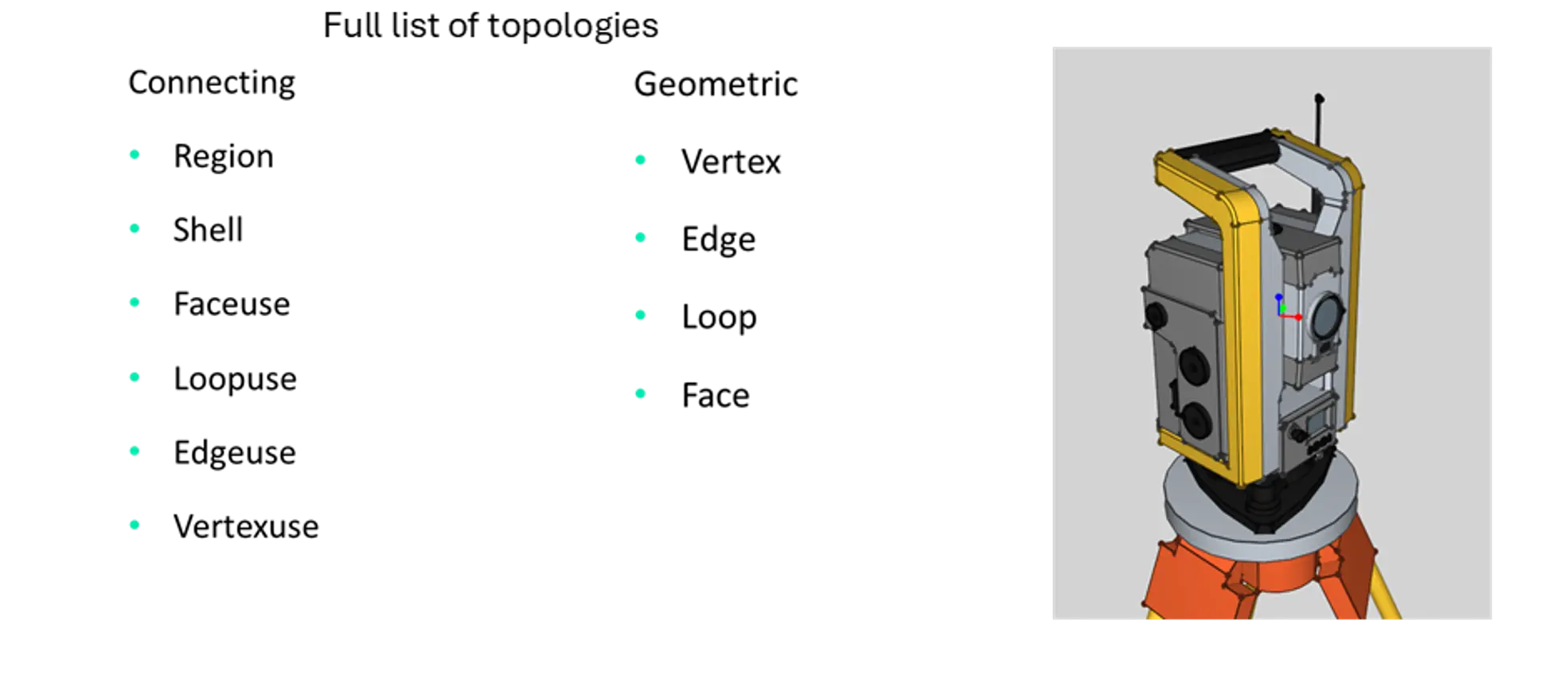
Qonic uses solid modelling with mathematically exact surfaces. This level of precision enables:
- Accurate interference detection
- Reliable clash detection
- Precise quantity take-offs
- Manufacturing-grade export capabilities
The same modelling standards used in aerospace and automotive industries are now applied to building digital twins.
Implications across the building lifecycle
Design phase
Architects and engineers work with full precision from the outset. Mechanical systems are modelled as they are intended to be built, rather than introduced later as simplified placeholders.
Construction phase
Contractors receive digital twins that reflect real-world conditions. Clash detection highlights actual conflicts, not artefacts caused by approximated geometry or missing detail.
Facilities management phase
Operations teams manage architectural and mechanical systems on the same platform, with the same level of data depth.
Consider a ventilator integrated into an elevator ceiling:
- Full mechanical geometry is preserved
- Technical specifications and manufacturer data remain accessible
- Maintenance history can be tracked over decades
- Replacement parts are defined with exact specifications
Assemblies can be broken down into individual parts, each ready to be maintained or replaced with confidence.
BIM 2.0 vision: one platform, one complete dataset
For Qonic, BIM 2.0 means working in a single platform where geometry and data are no longer separated.
One complete and accurate geometric model is directly linked to a complete and structured dataset. That connection remains intact from early design through construction and into decades of operation and maintenance.
This stands in contrast to how buildings are managed today. Geometry often lives in one system, while operational data sits in another. Mechanical detail is simplified during design and gradually degrades as changes accumulate over time. Many elements that enter a BIM model as placeholders were never intended to support long-term facilities management.
BIM 2.0 aims to close that gap. The goal is a true digital twin that remains useful beyond design coordination, and that supports real operational decisions throughout the entire building lifecycle.
What’s next
This is the second article in a ten-part series exploring the technical requirements of BIM 2.0 and builds on a technical reflection by Erik de Keyser, who described BIM 2.0 as a technological reset for the industry.
His original article explores the broader implications in more depth.
The next article will focus on why BIM 2.0 requires a cloud-native architecture, rather than simply delivering existing BIM tools through a browser.
If this perspective on BIM 2.0 resonates with you, feel free to share the article with colleagues. It helps move the conversation, and the tools behind it, forward.
Try Qonic
You can explore this mechanical-grade precision in a browser-based BIM environment: app.qonic.com
Questions or feedback?
We’d love to hear your perspective.
Email us at info@qonic.com, connect on LinkedIn, or join the Qonic community to continue the conversation.