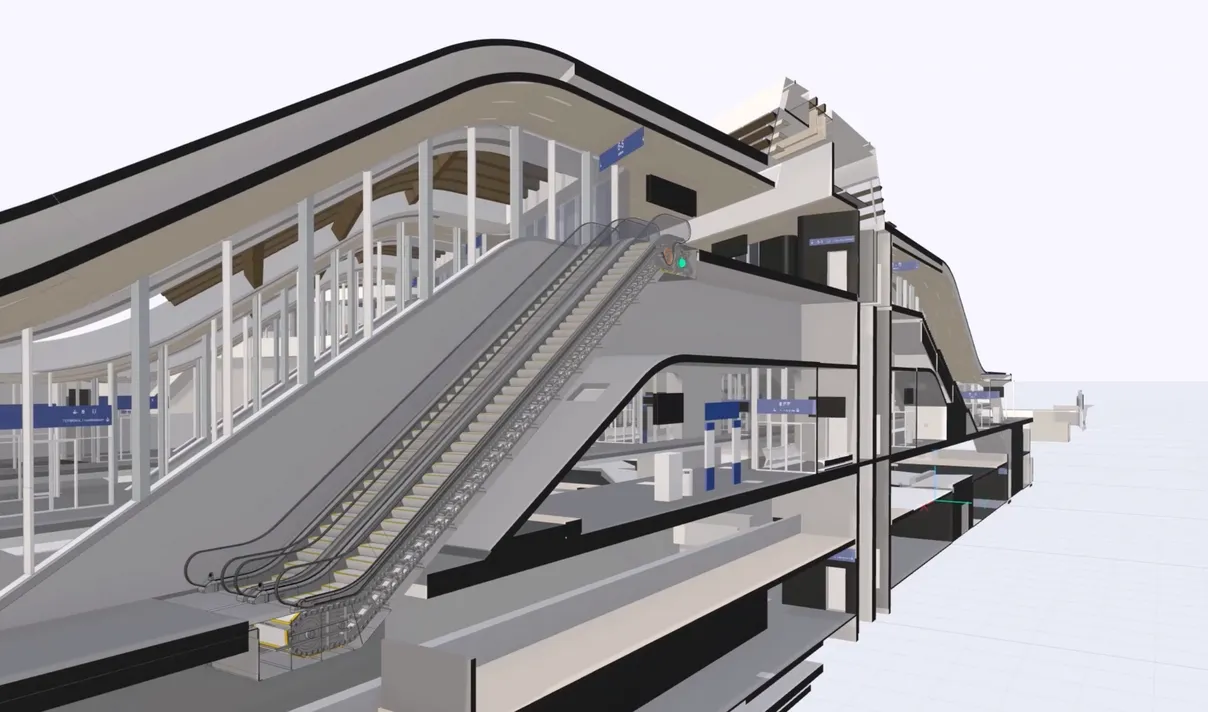
Qonic defines BIM 2.0 not as an incremental software update, but as a technological reset. Traditional BIM often suffers from “legacy bloat”- outdated data structures and file-based workflows that lead to inaccuracies. The coming weeks we will address several topics that we consider crucial for BIM 2.0.
Here is the list of next episodes:
- Mechanical-grade precision
- Modeling with B-Reps (solids) in BIM 2.0
- 3D modeling and 2D drawings
- High-Fidelity Quantity Take-Off (QTO) via Geometric Normalization
- Qonic’s Geometric AI combined with other AI methods
- Visual Planning
- Spaces
- APIs for data and geometry
- Pricing policy
- ROI today
Following is a non-limiting list of fundamentals we consider mandatory for BIM 2.0.
BIM 2.0 must enable a cloud-native and file-free collaboration. It must move away from ‘monolithic files’ toward a database driven approach.
BIM 2.0 needs ‘live accuracy’ for modeling and reports such as Quantity-take-offs’, planning, quality assurance, etc.
BIM 2.0 needs geometry modeling with mechanical-grade precision – we call it one-on-one ‘As Build’ precision. It should be made possible by easy 3D direct modeling operations. Users should be able to “push and pull” geometry freely. This removes the rigid constraints of traditional parametric modeling, allowing for complex architectural forms without breaking the model. Those easy modeling operations must use the same UI on PC, Mac, iOS, Android and web browsers.
BIM 2.0 must be able to handle high-resolution details (e.g. detailed façade construction or complex wall layers) across massive datasets, even entire city models, without performance lag.
BIM 2.0 must be built on Open BIM (IFC) standards or any equivalent and should provide APIs for geometry and data enabling custom workflows to ensure it doesn’t become another closed silo.
BIM 2.0 must provide unlimited visual feedback. In a highly detailed complex building existing of several models – architectural, structural, MEP… - the hundreds of thousands individual elements must be visually trackable in a blink of an eye, so to speak.
BIM 2.0 needs a proactive monitoring system for agentic watching over the integrity of geometry and data.
Any BIM 2.0 implementation may never close in its users. It must allow the user at his discretion to stop the service and download his complete set of geometry, data and metadata.
BIM 2.0 must span the process with an uninterrupted workflow starting from early design till the demolition of the building. That includes maintenance of building elements and huge mechanical systems and elements. All stakeholders – architects, engineers, constructors, manufacturers building owners and operators – should easily do their job on one unified platform. The digital twin must continually stay ahead of the execution of the building and not run ‘after the facts’. That requires extreme ease of use.
Although AI holds big promises, today it can’t drive the whole process. We see it as a gradually growing assistant and are embracing the power of it. More about it later.
This is about what is available now and in the next quarters.
About
Erik de Keyser is Co-Founder of Qonic. He previously founded and led Bricsys for 18 years, building it into a global player in professional CAD and BIM software. That journey gave him deep insight into what the AEC industry needs—and where traditional approaches fall short. In 2021, he co-founded Qonic with former colleagues and supports it financially to fundamentally rethink BIM from the ground up.