

For the Trimble 0–60 Challenge, we spent 60 days building a solution focused on the transition from early design to construction-ready BIM.
See the result in the full live demo from the main stage at Trimble Dimensions in Las Vegas:
The challenge
Design teams love tools like SketchUp for their speed and freedom. They’re perfect for exploring form and intent.
But when those models move downstream, often via Trimble Connect, they rarely contain the structured data needed to make them buildable.
That means there’s no reliable information for quantities, classifications, or construction details, it’s just geometry. So when projects move from concept to execution, teams are forced to rebuild, reattach and recheck everything.
So we asked ourselves:
What if you could give your SketchUp model BIM superpowers: structure, IFC data, and collaboration without redrawing ?
You could already import SketchUp models into Qonic, read how here, but with the Trimble 0–60 Challenge, we’ve gone further.
The solution
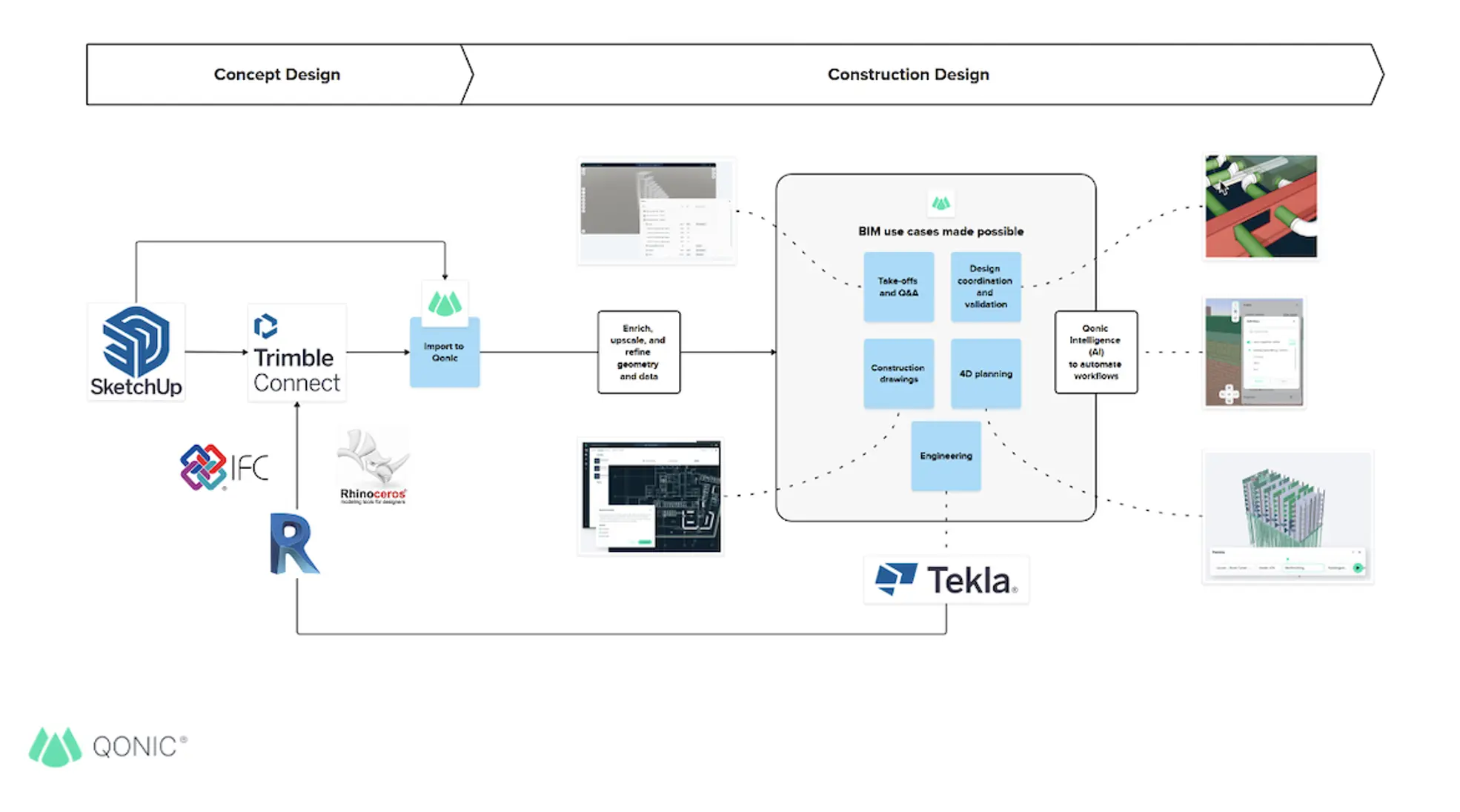
As part of the Trimble 0–60 Challenge, we developed a workflow that connects SketchUp directly to Qonic’s cloud-based BIM platform through Trimble Connect.
This connection allows designers and contractors to take a SketchUp model and turn it into construction-ready BIM.
Qonic automatically adds structure and enriches elements with IFC data. This enables:
- Easy Quantity take-offs
- Construction drawing generation directly from the model
- Design coordination and clash detection
- 4D planning and data-linked scheduling
In short: use what’s already there and make it work better.
The impact
What makes this workflow powerful is its simplicity. Instead of exporting, translating and cleaning up data across tools, Qonic keeps everything synchronised. Every edit, every parameter, every connected model stays in one environment accessible through the browser, without hardware limits or manual rework.
VolkerWessels, one of the largest contractors in the Netherlands, put it plainly after seeing Qonic in action:
"Qonic connects design, estimation and execution by combining geometry and data: one model, one truth, and maximum savings in time and cost."
— Niek Rooijackers, VolkerWessels
The numbers confirm it: teams work 2x faster and see a 3x reduction in coordination costs.
Why it matters
BIM was meant to unite design and construction, but too often it divides them.
By connecting SketchUp’s speed with Qonic’s precision, we’re bridging that gap and enabling real collaboration between concept and execution.
Looking ahead
Being selected as a finalist for the Trimble 0–60 Challenge was an incredible opportunity to build, to collaborate, and to show the AEC industry how far open BIM can really go.
At Trimble Dimensions 2025 in Las Vegas, we took the workflow to the main stage. Watch the full 5-minute demo above to see exactly how it works.