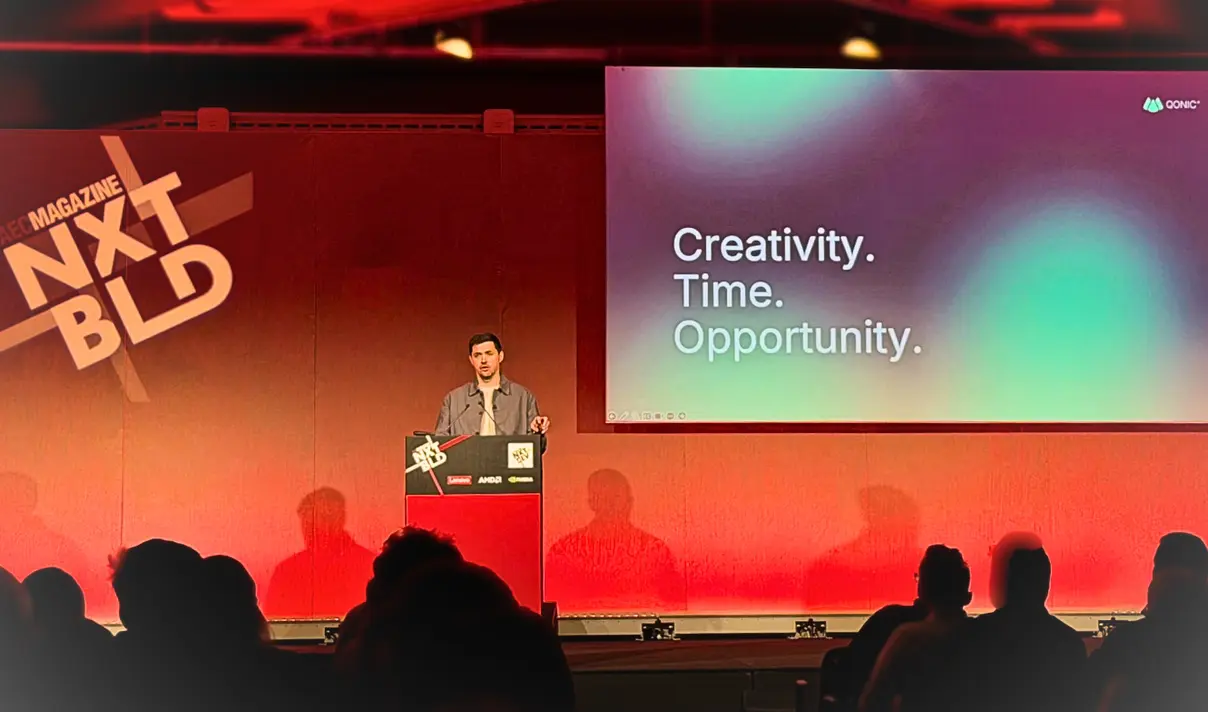
At NXT BLD 2026 in London, one thing was clear: AI is being added to almost every AEC product, in one form or another. Chatbots. Agent integrations. Generative concept tools. The pattern was everywhere.
The conversation around AI in AEC has leaned heavily toward the creative end of the process: generative concepts, massing studies, and design explorations that used to take days. That is genuinely useful. Yet the delivery phase is exactly where the industry spends its time and profitability.
A layer on top of your software
Most AI tools in the BIM ecosystem operate above the model. They can read data, generate reports, and flag issues. What they cannot do is directly manipulate the geometry itself: the edges, surfaces, and spatial relationships that define a building.
Qonic is built differently. Our geometry kernel and AI tooling are integrated at the code level and the AI operates inside the model. That makes instructions like "add moisture-resistant plasterboard to every bathroom" or "apply this skirting board profile to every apartment" executable as real geometry, at scale, without simplification or export.
The gap between finding and fixing
Most BIM workflows already have enough ways to find problems. What they lack is a way to resolve them. A system that identifies 15,000 doors missing a fire rating has not saved the team much time. A system that assigns FD30 across every non-compliant instance and corrects the metadata syntax is something else entirely.
Resolving compliance automatically
The same integration applies to compliance. Qonic evaluates models against a client's Information Delivery Specification (IDS) automatically and can resolve many common forms of non-compliance without manual intervention.
Agent-to-agent collaboration
Because Qonic is built on open IFC natively, this extends to collaboration between agents across different platforms. At NXT BLD, we announced the first agentic integration between Qonic and KOPE, a tool that maps design intent to real construction products and tells you, while you are still modelling, whether what you are designing can actually be built.
The geometry stays live in Qonic. KOPE can read it, validate it, and return feedback without either side losing what makes it useful. The integration is currently running as a prototype. If you want to know more, get in touch.
Adding AI is no longer the hard part. Everyone is doing it. What matters is whether that AI can actually get inside the model.
Try Qonic free on your own project. Want to see agentic BIM on a real model? Talk to our team.